Aja's Alopecia Journey: My Three Life-Changing Phases with Hair Loss
My 3 Phases with Alopecia
My name is Aja, and I am 36 years old. My husband and I are parents to two girls aged 7 and 10, and we live in a small village just south of Aalborg.

I have had Alopecia areata for 26 years
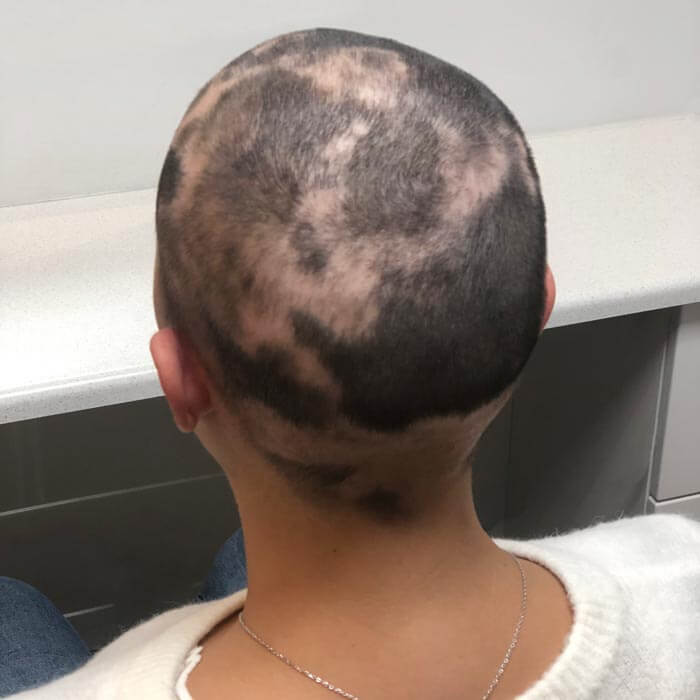
Alopecia areata is an autoimmune disease in which you lose your hair in patches. Everyone with Alopecia has their own story. This is a small glimpse into mine. You can follow me on Instagram under the profile: off_the_top_of_my_head
1st Phase – Panic and Uncertainty
My hair loss began when I was 10 years old and just wanted to be like everyone else. It started as a small patch in my fringe that slowly but steadily grew larger and larger.
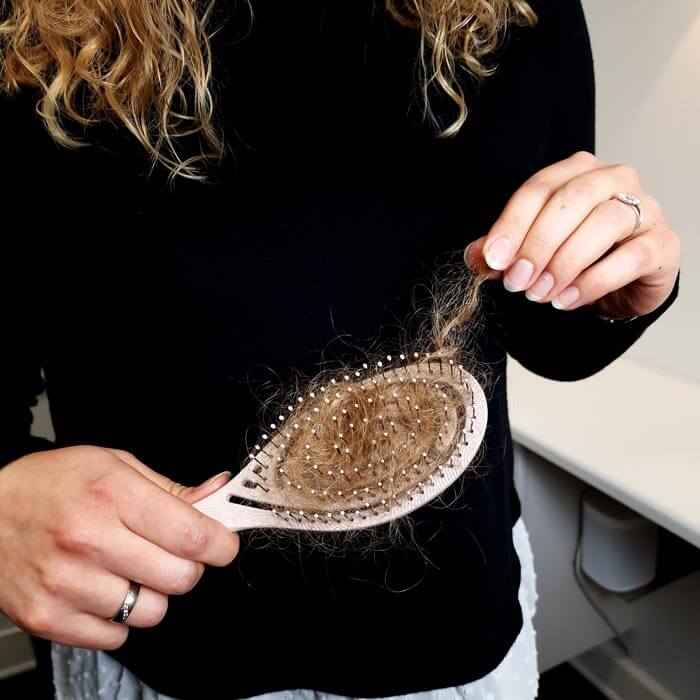
Every time I touched my hair, brushed it, or washed it, more fell out. I tried creatively to hide all the bald patches with clips and hairspray. I desperately tried to hold on to the hair I had left, but the hair loss continued for about a year until, in the end, there was not a single hair left. It may sound silly that I did not cut it off when there were only a few strands left, but at that time it was simply too painful a decision to make. I was in crisis. I did not want to accept that I was bald and looked sick. I cried many tears.
 |
 |
 |
It was very painful for my parents to see how sad I was, and they worried about how I would get through it. They did everything they could to explore treatment options and support me in the process. In general, I felt that I could talk to them about how I was feeling, but I also kept some emotions and experiences to myself because they were too difficult to share and because I wanted to protect them from further worry.

For me, the uncertainty of whether my hair would grow back was exhausting. I saw a dermatologist who started various treatments, including radiation therapy and oils I had to sleep with at night, but with no effect. I wore a cap to make my baldness less noticeable. People often mistook me for a boy, and at that age it was very difficult to deal with looking like—and being referred to as—a gender I was not. To this day, I still have a complicated relationship with caps.
I started doing gymnastics, but it was not easy to tumble while wearing a cap. I chose to do it anyway and made it work despite the inconvenience.
Many of my classmates were kind and protective, but I remember not really talking to any of them about it. A few classmates made hurtful comments and said things behind my back. Sometimes someone would grab my cap or accidentally knock it off. There were many small incidents in my encounters with others that lodged inside me like microscopic shards of glass.
I felt like a hunted animal, always on guard, afraid of being exposed and scared that my illness would become the center of attention. After about a year of being completely bald, my hair slowly began to grow back across most of my scalp, starting as soft fuzz that gradually became stronger. I was filled with relief.

At my confirmation, I had a short bob and only one bald patch left, which the hairdresser was able to hide. Sitting on the bench in the church, I was so happy that my cap would not be part of the confirmation photos. That day I was not worried about my hair, but about my white dress because I had just gotten my period. It is not always easy being 14 years old.
But it did not take long before the hair loss started again. As before, it began with a small patch that grew larger, but this time I did not lose all my hair. The patch eventually stopped spreading and the area was completely hairless and rubbery for a long period before the hair returned.
Meanwhile, the hair loss began in other places. It kept moving around like a map in constant motion, and that is how it has been ever since. In my teenage years, photos might make it look like I had perfectly normal hair, but I always had larger or smaller bald areas that I tried to hide with strange hairstyles. During that period, I used almost all my energy to hide my hair loss and to cope with feeling wrong and ashamed of being partially bald. I did not know any other girls or women without hair and had no one to mirror myself in.
I remember it as very lonely carrying all the thoughts and doubts by myself. It was wonderful to have really good friends and a family who loved me unconditionally. But it was exhausting constantly working to hide something that is so difficult to hide, and always fearing being exposed.
I had some tough childhood years filled with worry, but they made me wiser about myself and, over time, helped me find a strength in being who I am and standing out—something I would not want to be without.
2nd Phase – Rebellion, Freedom, and Taking Control
I can best describe the next phase as simply having had enough. I had just celebrated my 17th birthday and decided that I did not want to hide anymore, realizing how much it was draining me. So the evening before the last day of school, I called my best friend. She came over and we trimmed off all my hair, of course trying ridiculous hairstyles along the way until we were crying with laughter. I had told my mother about my decision beforehand, and she thought I should wait until I had a wig I could wear if I regretted it. But I had no doubt about what I wanted.
 |
 |
The next day, biking to high school completely bald, it was surprisingly cold—but I have never in my life felt so free. At last, I could take back control and decide my own appearance after years marked by loss of control. At that time, I did not see any other possibilities. Once I had made the decision, I spent very little energy thinking about what others would say or how I would look. My focus was on creating change and moving away from a mentally exhausting situation that had lasted for years.
Because I had hidden for so many years, it became very important for me not to hide anymore, and therefore I did not see a wig as an option. I did not want to feel that I was once again hiding my lack of hair.
Choosing life as a bald woman brought countless experiences: stares, comments, shouts on the street, questions, approaches, and opinions about my appearance or my person. But none of it compared to the feeling of hiding. That is not to say there were not days when people’s comments affected me, and we can ask ourselves whether it is ever really fair to comment on other people’s appearance.
It was an enormous relief not to constantly carry a cloak of worry, and I radiated confidence. I could finally relax and be myself. There were episodes that were far from funny—for example, when someone told me I was ugly, that I looked like a baby, or shouted “chemo freak” at me in the street. But it could not break me. No one and nothing could take my choice away from me.
Since I was 17, I have used a trimmer every week or every other week on the areas where hair grows. In some periods I was able to grow a small bun on top of my head, but never for long, and always with a bit of sadness when I had to shave it off again. It took time to find my style as a bald woman, and some things definitely worked better than others. I have generally been interested in what femininity really is and the social norms connected to it. Many people associate femininity with having hair, preferably long hair, but I believe you can create an incredibly feminine look while bald. I have learned that a good dose of self-worth, a straight back, red lips, big earrings, and the belief that most people wish you well can take you far.
I have always used scarves in summer to tie different turbans to avoid sunburn. I enjoy playing with various styles and ways of tying them, and generally working on how to create the volume you would have if you had hair. I have felt enormous freedom being bald, but there have certainly been environments where, as a bald woman, I found it much easier than in others. For example, you blend in far more at a music festival than when walking around Legoland with your family.
 |
 |
I have the most wonderful and open-minded husband and the sweetest children, who have never been able to imagine having a mother with hair. With big smiles they have said, “My mum is bald as an egg,” almost as if it were a value in itself. In youth and adulthood, I have learned that there is great strength in daring to stand out, even though it has also been tiring to deal with others’ looks and opinions every single day I stepped outside.
3rd Phase – The Freedom to Choose
Looking back, I realize I was locked into a sense of being wrong, thinking that if I wore a wig I would be hiding my baldness—and that it had to be either-or because other people would not be able to understand it. But then my thirties came, and I began to realize that I can do exactly what I want, when I want. Over the years of being bald, I have become even less concerned about other people’s opinions of me.
At times, it has been boring always looking the same and never being able to style my hair for a party or change my look with a new hairstyle. I have always loved dressing up—and who decides that you must look the same every day? So at the age of 35, I got my first real wig and started wearing it whenever I felt like it. At first it was slightly intimidating, but also really fun and refreshing. Today I have several wigs to switch between, and I love being Ginger Spice one day, bald the next, and wearing a turban the third. I am no longer afraid of feeling like I am hiding if I wear a wig, because it is me who decides what I want. But honestly, there is still a tiny, microscopic feeling inside me that others might think I wear a wig to hide my baldness. At the same time, I accepted long ago that I cannot control what others think. People look at me in the street because I stand out from the norm, and I cannot change that. So I do not spend my energy on it.
 |
 |
 |
 |
Minorities of all kinds are stigmatized, to varying degrees, in the society we live in. My mission is to challenge the boundaries of what is allowed to be considered beautiful and to help normalize all kinds of bodies—so people are respected equally, regardless of who they are or what they bring. Fortunately, body activists and body positivity advocates are gaining ground, and there is a broader movement pushing back against society’s, media’s, and advertising’s narrow portrayal of what the “right body” should look like.

The moment I feel most feminine is when I am completely myself—bald as I am—with bold colors and wild energy. Over time, I have found my own path with Alopecia and can now rest in not having hair.
It is so important that each of us learns to stand up for who we are and hold on to the fact that we are allowed to look the way we do, without feeling limited or wrong. Some are forced to confront this from an early age. I was.
- Aja