
What is Alopecia Areata?
Alopecia areata, as the name suggests, is patchy hair loss. It occurs suddenly and can affect both men and women, young and old alike. In medical terms, it is called alopecia areata and is an autoimmune condition in which the body’s own immune system attacks the hair follicles. This causes all the hairs in a limited area to fall out, and the hair follicles go dormant before they begin producing new hairs again. It is not only the hair on the scalp that can be affected. Alopecia can also occur in the beard, eyebrows, and eyelashes.


How Does Alopecia Areata Develop?
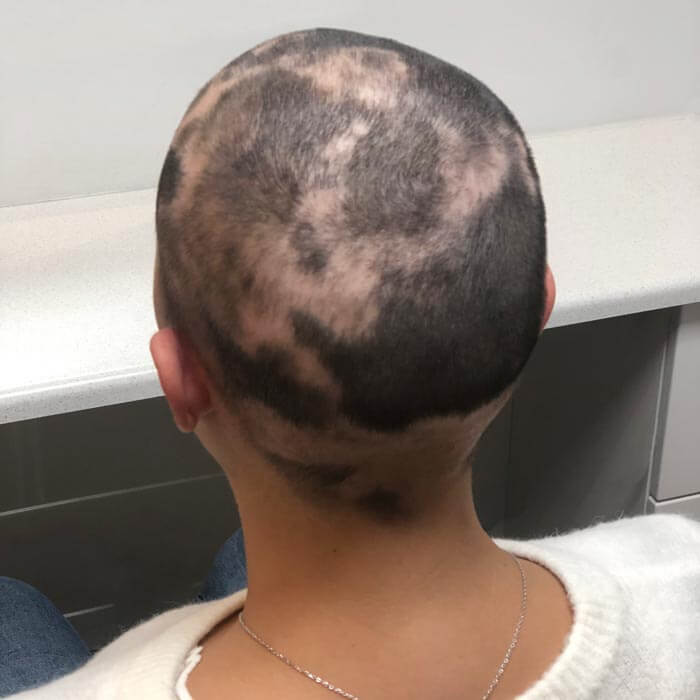
Alopecia areata begins with small, round patches a few centimeters in size where the hair has fallen out. Often, several of these patches appear at the same time. These bald areas may grow in size and change shape, and they can even shift to different areas of the scalp. The course of alopecia areata varies significantly from person to person.
According to information from sundhed.dk, half of those who experience alopecia regrow their hair within 6–12 months. For others, the condition may remain active for several years, and even if hair begins to grow back in previously bald areas, new patches may appear elsewhere.
Sundhed.dk reports that around 80% of people with alopecia areata regain their hair at some point. However, the new hair may undergo pigment changes, and in some cases, it may grow back white. This phenomenon can be temporary, but it may also result in a permanent change in the affected area.
After experiencing alopecia areata once and regrowing all the hair, there is unfortunately a risk of relapse later in life. Alopecia areata can also develop into alopecia totalis, where all scalp hair is lost. A small number of individuals may even develop alopecia universalis, where all hair on the entire body is lost, including eyebrows, eyelashes, body hair on the arms and legs, and pubic hair. This involves complete hair loss over the entire body.
How Do I Know If I Have Alopecia Areata?
Several factors can contribute to hair loss, including stress, vitamin deficiencies, and various medical conditions. For this reason, it is recommended that you consult your GP, who can carry out a thorough examination. If your doctor suspects alopecia areata, you will be referred to a dermatologist who has the expertise to make the correct diagnosis.
Why Do People Get Alopecia Areata?
The exact cause of alopecia areata remains unclear. However, research indicates that genetics likely play a significant role in the development of the condition. Additionally, some studies suggest that factors such as psychological stress, infections, and other autoimmune diseases, including diabetes and thyroid disorders, may act as triggers for hair loss in individuals with a genetic predisposition.
Can Alopecia Areata Be Cured?
The short answer is no. If you have alopecia areata, it is important to understand that your hair follicles are in a dormant state, and there is an 80% chance that your hair will grow back. There is currently no miracle cure to wake the hair follicles from this dormant phase, although intensive research is ongoing in this area. Over the years, attempts have been made with vitamin and mineral treatments, various medications, and special shampoos, but without documented effect. For this reason, we recommend patience and allowing time for the condition to develop naturally.
Can Toftild Help with Alopecia Areata?
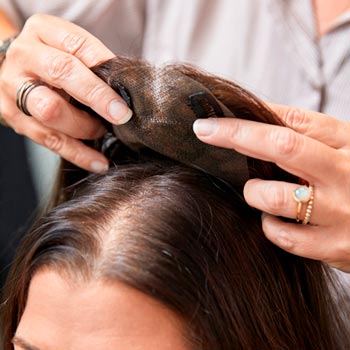
Yes, we can. We always carry out an individual assessment of the patchy hair loss and find a solution based on your specific needs. We can offer small custom-made hair pieces that match your own hair. We create a template based on your scalp and either glue or tape them onto the bare patches. We also offer a hair topper, which clips onto your own hair and covers thinning or bare areas. If the hair loss is more extensive, we of course also offer wigs. All hair solutions from Toftild – both in synthetic fiber and human hair – look natural and blend seamlessly with your own hair.
|
|
 |
 |
Financial Support for Hair Solutions
If you have received an alopecia diagnosis from your dermatologist, you may apply to your local municipality for financial support for a hair solution. This support, known as a grant, covers the cost of purchasing a wig or toupee and is awarded under Section 112 of the Danish Social Services Act. Applications are submitted via borger.dk under the category "assistive devices." In Denmark, you always have free choice of supplier, meaning that even if a specific supplier is named in your grant, you are free to choose where to purchase your new hair. In other words, you can always choose Toftild, regardless of the supplier name stated in your grant. At Toftild, we can also guide you through the process of applying for financial support for a wig, toupee, or other hair loss solutions. Further information about financial support options for wigs and toupees can be found here.